
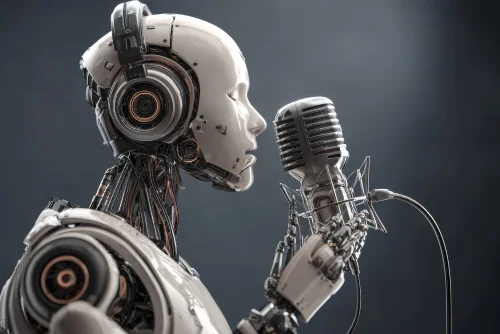
Artificial intelligence (AI) is rapidly advancing its presence in the arts, creating what many consider a "Napster moment" for the entertainment industry. For the past few years, the vocal likenesses of public figures and artists have been used to generate highly realistic synthetic audio. This technological shift places immense power in the hands of everyday users, challenging our traditional understanding of originality and raising a pressing question for artists and citizens alike: Can AI legally copy my voice?
While the technology exists to replicate your voice with startling accuracy, the legality of doing so without your permission is a highly contested gray area.
The Rise of AI Cover Music and Voice Clones
Today, AI models require increasingly little input to generate realistic audio. State-of-the-art tools can synthesize a highly accurate voice clone from just a short sample of audio. Because of this accessibility, there has been a growing occurrence of AI-generated music made in the style of well-known artists available across streaming platforms and YouTube.
A few high-profile incidents have recently thrust this issue into the global spotlight:
- The Fake Drake & The Weeknd Track: In the spring of 2023, an anonymous creator released an AI-generated song called "Heart on My Sleeve," which flawlessly mimicked the voices of Drake and The Weeknd. The song went viral before Universal Music Group issued aggressive takedown notices, citing copyright violations and the unauthorized use of the artists' likenesses (The Verge, 2023).
- Scarlett Johansson vs. OpenAI: In May 2024, actress Scarlett Johansson threatened legal action against OpenAI after the company released a voice assistant that sounded eerily identical to her, especially concerning given she had previously declined their request to license her voice (TIME, 2024).
- Generative AI Lawsuits: We are also seeing class action copyright infringement lawsuits filed against platforms like Suno AI, a popular AI music generator, alleging that the models were trained on copyrighted music without authorization or compensation.
- Murphy Campbell: In early 2026, Murphy Campell (a singer/songwriter from North Carolina) was subject to a copyright takedown request based on AI fakes of her music. It is surmised that someone had scraped her performances on YouTube, run them through AI voice cloning, and uploaded synthetic covers under her name to Spotify (The Verge, 2026). Campbell eventually managed to get most of the fakes removed.
The Legal Framework
For the world we currently live in, AI sits in a legal gray area in the United States. The last major revision of U.S. copyright law was the Copyright Act of 1976, long before anyone could fathom publicly available AI capable of writing music and mimicking human voices. Currently, there is no single federal law uniformly banning the unauthorized creation of AI voice clones. Instead, attorneys are applying existing frameworks to these new paradigms, such as outlined below:
Right of Publicity: People do not have an absolute right to prevent all impersonations of themselves. Parody and impersonation have long been protected mediums in comedy and commentary, so long as they fall within the parameters of fair use. However, under some state right of publicity laws, using someone's vocal persona is generally actionable if done to commit fraud or achieve commercial gain, and is done without permission from the owner of the "voice." For example, Tennessee recently enacted the ELVIS Act, which explicitly expands its right of publicity to protect individuals from the unauthorized AI simulation of their voices.
Copyright Law: Existing federal copyright law protects sound recordings set in a tangible medium, but it does not protect the underlying "voice pattern" itself or a general right against imitation. “My Body, My Voice: Defining Vocal Identity Rights To Combat Ai-Generated Deception" (29 Marq. Intell. Prop. L. Rev. 349).
AI Authorship: Can you own an AI-generated song? In the prominent case Thaler v. Perlmutter, 130 F.4th 1039 (D.C. Cir. 2025), the court affirmed that works generated entirely by AI cannot be copyrighted. While users may generate and post AI music, claiming it as their exclusive intellectual property remains legally fraught.
A Rapidly Evolving Landscape
Because technology is developing faster than the law, how AI-generated content will be prevented or protected by intellectual property is currently in a state of flux. Instead of Congress enacting sweeping laws and regulations, we are seeing rapidly evolving, makeshift efforts to respond to the challenges of artificial intelligence.
State legislatures are beginning to act, as mentioned above. At the federal level, bipartisan proposals like the NO FAKES Act aim to establish a uniform standard for digital replicas, though it remains to be seen how these proposals will balance individual rights against First Amendment protections for creators.
Conclusion
Because of the nuances in the law, it is impossible to take a hard, universal position on whether a specific instance of voice cloning is illegal without all of the underlying facts. The viability of a claim depends heavily on state laws, the nature of the audio used, the commercial intent of the user, and the evolving doctrine of fair use.
Whether you are a recording artist concerned about unauthorized AI covers, a podcaster discovering your voice on a text-to-speech app, or a business professional looking to legally license synthetic voices, navigating this landscape requires highly specific legal guidance. You should consult a qualified intellectual property attorney to evaluate your unique situation, ensure your safety, and protect your digital identity in the age of AI.
 Senior Attorney
Michael’s practice focuses on electrical and software engineering related technologies, such as wireless communications, cloud computing, and consumer devices.
He regularly provides intellectual property related counsel ...
Subscribe
Recent Posts
- A Promising Change to USPTO Pre-Appeal Review: A Reason to Reconsider the Procedure?
- The Dupe Economy: What Fashion Brands Can and Can't Do About Copycats
- Aligning IP Strategy with Business Reality: A Guide to Patent Portfolio Reviews
- When IP Enforcement Becomes the Story: Trade Dress, Antitrust, and Fee-Shifting After Deckers v. Quince
- Design Patents in the Real World: Lessons from Deckers’ UGG® Design Patent
- Charting the Next IP Course: Design Patents, Software Platforms, and the Automotive Aftermarket
- America at 250: Made in USA Claims Deserve a Fresh Look Before the 4th of July
- Patent Danger in the Age of Free AI Tools
- Design Patent Examination at the USPTO: DesignVision, AI, and the New Rules for Digital Designs
- Extending Your Patent: Continuation and Divisional Patent Practices & Strategies in Worldwide Jurisdictions
Archives
- October 2026
- September 2026
- July 2026
- June 2026
- May 2026
- April 2026
- March 2026
- February 2026
- December 2025
- November 2025
- October 2025
- September 2025
- July 2025
- June 2025
- May 2025
- April 2025
- February 2025
- January 2025
- November 2024
- September 2024
- August 2024
- June 2024
- May 2024
- April 2024
- February 2024
- January 2024
- December 2023
- November 2023
- October 2023
- September 2023
- August 2023
- July 2023
- May 2023
- April 2023
- March 2023
- February 2023
- January 2023
- October 2022
- August 2022
- June 2022
- May 2022
- April 2022
- March 2022
- February 2022
- January 2022
- December 2021
- November 2021
- October 2021
- September 2021
- August 2021
- July 2021
- June 2021
- May 2021
- April 2021
- March 2021
- February 2021
- January 2021
- December 2020
- November 2020
- October 2020
- August 2020
- July 2020
- June 2020
- May 2020
- April 2020
- March 2020
- February 2020
- January 2020
- November 2019
- October 2019
- September 2019
- June 2019
- April 2019
- February 2019
- January 2019
- October 2018
- July 2018
- June 2018
- May 2018
- April 2018
- March 2018
- February 2018
- January 2018
- December 2017
- November 2017
- October 2017
- August 2017
- July 2017
- May 2017
- April 2017
- March 2017
- February 2017
- January 2017