
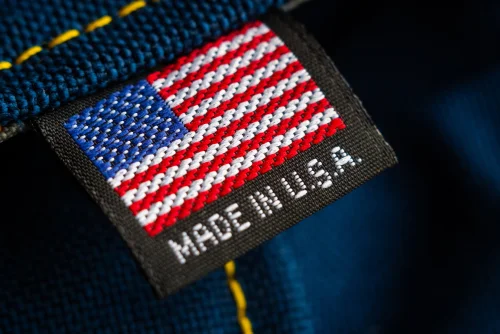
The Fourth of July is a natural opportunity for brands to focus on patriotic messaging, especially around America’s 250th celebration.
“Made in USA,” “American made,” “Built in America,” flag imagery, red, white, and blue packaging, and references to American workers or craftsmanship are all powerful marketing tools. They are also high risk advertising claims when the product, components, or manufacturing process do not fully support the claim. Accordingly, here is a timely reminder for companies to review how U.S. origin claims appear across packaging, websites, social media, product listings, catalogs, and retail displays.
At issue is not just the exact phrase “Made in USA.” Patriotic imagery and related language can create an implied origin claim if the overall message suggests that a product is made in the U.S. The basic legal standard is straightforward but strict. Under the FTC’s “Made in USA” standard, an unqualified U.S. origin claim generally requires that the product be “all or virtually all” made in the U.S. That means final assembly or processing must occur in the U.S., all significant processing must occur in the U.S., and all or virtually all ingredients or components must be made and sourced in the U.S.
Final assembly in the U.S. is not enough by itself. A product may still fall short if it contains significant foreign components or if important processing occurs outside the U.S. The FTC analysis is not purely mathematical. Therefore, even where a foreign component or processing accounts for a small share of the total product cost, it may still be significant if it contributes meaningfully to the product’s function, appearance, or consumer value.
Exaggerated and unsupported “Made in USA” claims carry significant risk. They can trigger FTC investigations or enforcement, including monetary penalties, corrective advertising, packaging and labeling changes, consumer notices, and ongoing compliance obligations. The risk is especially high where a brand makes an unqualified claim, such as “Made in USA,” “American made,” or “Built in America,” without substantiation that the product is all or virtually all made in the U.S.
Competitors may also assert Lanham Act false advertising claims where patriotic or U.S. origin messaging allegedly misrepresents the geographic origin of goods and diverts sales. U.S. state’s unfair competition and false advertising laws, such as California's specific “Made in USA” statute, may impose separate and additional requirements.
Before launching any patriotic themed campaigns, companies should consider the following reminders:
- Review the net impression, not just the words. U.S. flags, maps, “American craftsmanship” language, military themes, and red, white, and blue packaging may imply U.S. origin even without saying “Made in USA.”
- Confirm whether the claim is qualified or unqualified. If the product does not meet the “all or virtually all” standard, avoid broad statements like “Made in USA,” “American made,” or “100% USA made” unless they are cleared.
- Audit claims by SKU. Do not assume that a claim works across a product line. One product may satisfy the standard while another version, size, color, component, or supplier arrangement may not.
- Confirm supplier documentation. Supplier certifications should be current, specific, and tied to the actual product or component. A supplier’s U.S. address or domestic final assembly step does not prove U.S. origin.
- Check all marketing channels. Claims can appear outside of labels and packaging, including Amazon listings, product descriptions, social posts, influencer briefs, paid ads, retail displays, and sales sheets.
- Be careful with “assembled,” “designed,” and “crafted” language. These claims can still mislead if they overstate the extent of U.S.
- Do not let holiday urgency override substantiation. Seasonal campaigns can move quickly, but U.S. origin claims should be reviewed before launch.
- Consider related labeling rules. Some product categories, including textiles, may have separate country of origin disclosure requirements that need to be evaluated alongside “Made in USA” advertising claims.
A strong U.S. “Made in the USA” claim can be a valuable brand asset. An exaggerated one can not only harm the brand but also open the door to FTC action or competitor lawsuits.
 Shareholder
Clients prize John’s wealth of creative ideas for growing and protecting their businesses. Naturally outgoing, he has developed an extensive network of contacts that benefit clients as he advances their interests. John works ...
Subscribe
Recent Posts
- A Promising Change to USPTO Pre-Appeal Review: A Reason to Reconsider the Procedure?
- The Dupe Economy: What Fashion Brands Can and Can't Do About Copycats
- Aligning IP Strategy with Business Reality: A Guide to Patent Portfolio Reviews
- When IP Enforcement Becomes the Story: Trade Dress, Antitrust, and Fee-Shifting After Deckers v. Quince
- Design Patents in the Real World: Lessons from Deckers’ UGG® Design Patent
- Charting the Next IP Course: Design Patents, Software Platforms, and the Automotive Aftermarket
- America at 250: Made in USA Claims Deserve a Fresh Look Before the 4th of July
- Patent Danger in the Age of Free AI Tools
- Design Patent Examination at the USPTO: DesignVision, AI, and the New Rules for Digital Designs
- Extending Your Patent: Continuation and Divisional Patent Practices & Strategies in Worldwide Jurisdictions
Archives
- October 2026
- September 2026
- July 2026
- June 2026
- May 2026
- April 2026
- March 2026
- February 2026
- December 2025
- November 2025
- October 2025
- September 2025
- July 2025
- June 2025
- May 2025
- April 2025
- February 2025
- January 2025
- November 2024
- September 2024
- August 2024
- June 2024
- May 2024
- April 2024
- February 2024
- January 2024
- December 2023
- November 2023
- October 2023
- September 2023
- August 2023
- July 2023
- May 2023
- April 2023
- March 2023
- February 2023
- January 2023
- October 2022
- August 2022
- June 2022
- May 2022
- April 2022
- March 2022
- February 2022
- January 2022
- December 2021
- November 2021
- October 2021
- September 2021
- August 2021
- July 2021
- June 2021
- May 2021
- April 2021
- March 2021
- February 2021
- January 2021
- December 2020
- November 2020
- October 2020
- August 2020
- July 2020
- June 2020
- May 2020
- April 2020
- March 2020
- February 2020
- January 2020
- November 2019
- October 2019
- September 2019
- June 2019
- April 2019
- February 2019
- January 2019
- October 2018
- July 2018
- June 2018
- May 2018
- April 2018
- March 2018
- February 2018
- January 2018
- December 2017
- November 2017
- October 2017
- August 2017
- July 2017
- May 2017
- April 2017
- March 2017
- February 2017
- January 2017